
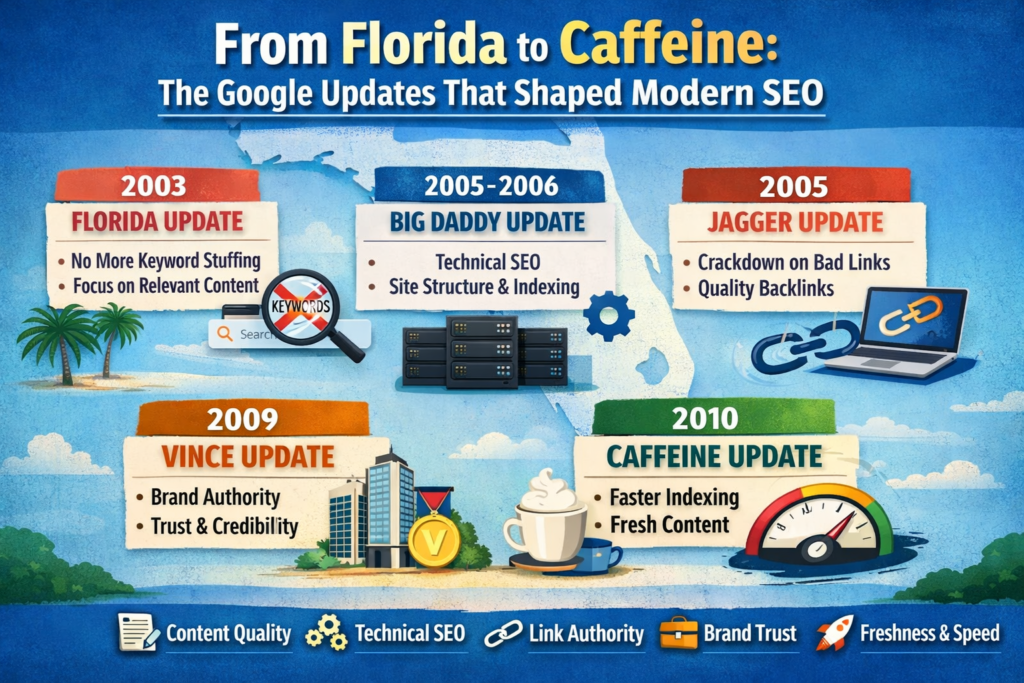
Search engine optimization has never been static. If you’ve been in digital marketing long enough, you’ll know that Google’s algorithm updates have completely transformed the way websites rank. Among the most influential updates in Google’s history are Florida, Big Daddy, Jagger, Vince, and Caffeine.
These updates didn’t just tweak search results—they redefined SEO strategies, eliminated spammy practices, and pushed businesses toward quality, credibility, and technical excellence.
Let’s break down how these five major updates shaped modern search and what they mean for digital marketers today.
1. Florida Update (2003),The End of Keyword Stuffing
The Florida update was one of the first major shocks in the SEO world. Launched in 2003, it dramatically changed how Google evaluated websites.
Before Florida, many websites were ranked simply by stuffing keywords into pages. Whether or not the information was useful was irrelevant. If you repeated a keyword enough times, you could climb the rankings.
Florida changed that.
Google started analyzing content contextually and penalizing manipulative practices such as
– Keyword stuffing
– Hidden text
– Excessive repetition
– Low-quality doorway pages
Many businesses saw their traffic drop overnight. It was a wake-up call.
– Impact on SEO:
Florida shifted the focus from tricks to relevance. It encouraged content that actually served users instead of just targeting search engines.
2. Big Daddy Update (2005–2006)—Technical SEO Matters
Big Daddy wasn’t about content. It was about infrastructure.
This update improved how Google handled:
– Canonicalization issues
-Duplicate content
– URL structures
– Redirects
– Crawl efficiency
Before Big Daddy, technical issues could sometimes be ignored. After this update, websites with poor technical structure struggled to rank.
For example:
* Multiple versions of the same page (HTTP vs HTTPS, www vs non-www)
* Improper 301 redirects
* Thin affiliate pages
Big Daddy made Google smarter at detecting these issues.
– Impact on SEO:
Technical SEO became essential. Website structure, clean coding, proper redirects, and server performance started to matter more than ever.
3. Jagger Update (2005) – Cleaning Up Bad Links
Jagger focused primarily on backlink quality.
At that time, link buying and link exchanges were extremely common. Many websites are ranked simply by building thousands of low-quality backlinks.
Jagger changed the rules.
Google started evaluating:
– Link quality over quantity
– Relevance of linking domains
– Paid link schemes
– Link farms
Websites relying on spammy backlinks saw ranking drops.
– Impact on SEO:
Backlink strategy shifted toward authority and relevance. Organic link building, guest blogging, and relationship-based outreach became more important than mass link building.
4. Vince Update (2009)—Branding and Trust Are Key
The Vince update surprised many SEO professionals. It seemed to favor large, established brands in search results.
For competitive keywords, big brands started ranking higher even if smaller sites had similar content quality.
Why?
Because Google began giving more weight to:
* Brand authority
* Domain trust
* Business credibility
* Offline reputation
This was a clear signal that SEO wasn’t just about optimizing pages. It was about building a real brand.
– Impact on SEO:
Branding became part of the search strategy. Businesses needed:
* Strong domain authority
* Consistent brand presence
* Trust signals (About pages, contact details, privacy policies)
* Media mentions and recognition
SEO and branding started working together.
5. Caffeine Update (2010): Faster, Fresher Search Results
Caffeine was not just an algorithm update; it was a new indexing system.
Before Caffeine, Google updated its index in large batches. After caffeine, indexing became continuous and much faster.
This meant:
* New content could rank quickly
* Fresh news articles appeared almost instantly
* Blogs and dynamic websites gained more visibility
Google improved its infrastructure to handle massive amounts of data more efficiently.
– Impact on SEO:
Content freshness became a ranking factor. Businesses that consistently published high-quality content gained a competitive advantage.
Blogging, content marketing, and real-time publishing became powerful SEO strategies.
– What These Updates Teach Us Today
When we look at Florida, Big Daddy, Jagger, Vince, and Caffeine together, a clear pattern appears.
Google has always moved toward:
1. Better user experience
2. Higher content quality
3. Technical excellence
4. Authentic link building
5. Brand trust
6. Faster information delivery
These updates laid the foundation for modern SEO practices we follow today.
If you are a digital marketer or business owner, here’s the real lesson:
* Don’t chase shortcuts.
* Build authority, not tricks.
* Focus on users first.
* Maintain technical health.
* Create content consistently.
Search engines evolve, but their goal remains the same—deliver the best possible result to the user.
– Final Thoughts
SEO is not about gaming the system anymore. It’s about aligning your website with Google’s long-term vision.
The Florida update removed manipulation.
Big Daddy strengthened technical standards.
Jagger cleaned up link spam.
Vince rewarded brand authority.
Caffeine accelerated content discovery.
Together, these updates shaped the modern digital marketing landscape.
If your strategy is built on quality, trust, structure, and consistency, you’re already aligned with the direction Google has been moving for years.
And that’s the kind of SEO that survives every update.